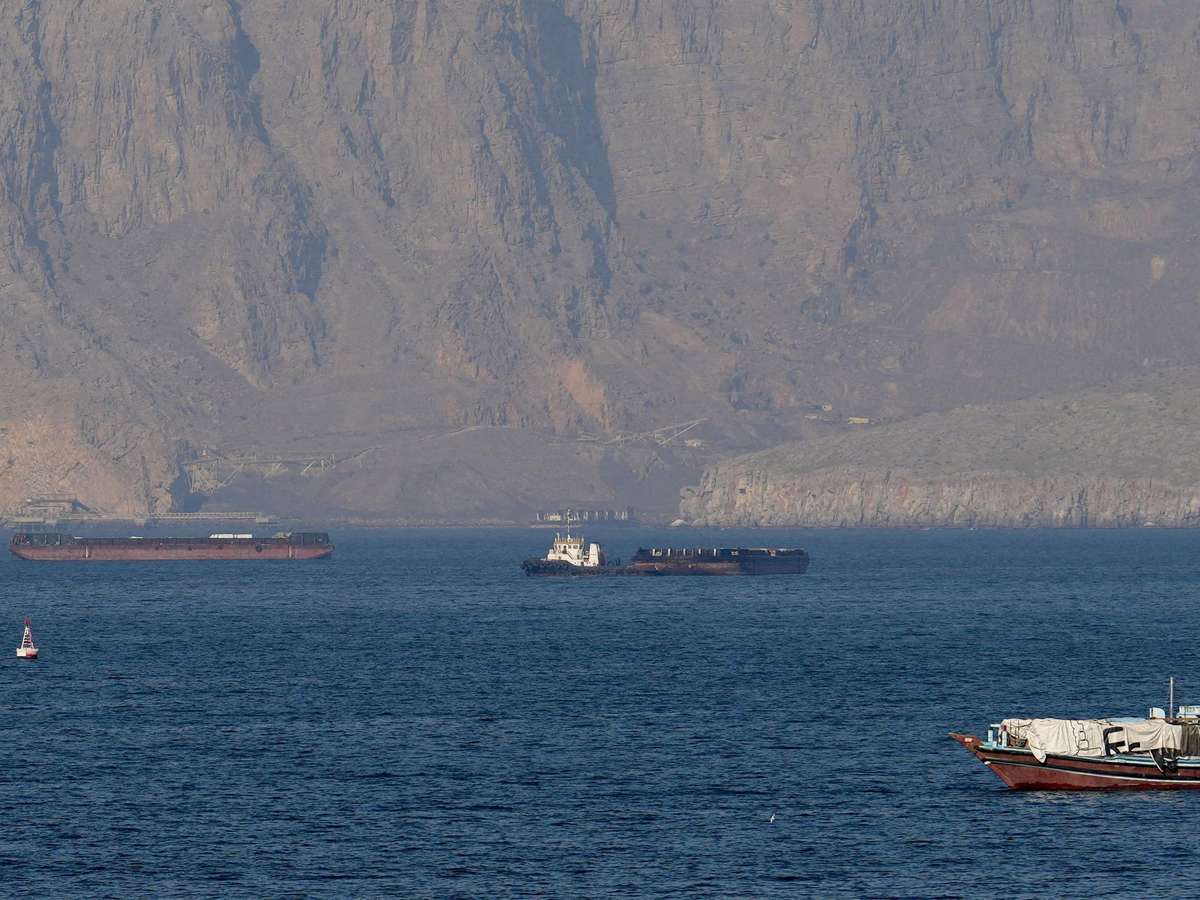
Iran has threatened to attack US forces if they enter the Strait of Hormuz, following Donald Trump's statement that the US would assist ships trapped in the area. Trump had said that the American military would begin guiding the trapped ships out of the strait starting on "Monday morning (4/5), Middle East time." Approximately 2,000 ships with 20,000 sailors have been unable to leave the strait since the beginning of the war between the US and Iran, the head of the International Maritime Organization stated last week. Iranian military officials say they control the strait and will attack "any foreign armed force" that tries to enter, "especially the aggressive American army." Trump claims that "Project Freedom" is a "humanitarian gesture," adding that "many ships have little food." American military officials stated that guided missile destroyers, over 100 aircraft, and 15,000 military personnel will be involved in the operation. The Strait of Hormuz is a vital maritime route in the Persian Gulf for oil tankers, tanker ships, and container ships. It has been effectively blocked for weeks due to Iranian attacks and the subsequent US naval blockade. 'Project Freedom' The announcement by the Iranian Armed Forces that they will attack American forces entering the Strait of Hormuz was made by the head of the Iranian central command. Major General Ali Abdollahi declared that Iran has already stated "repeatedly" that the strait "is under the control" of the Iranian Armed Forces and that
safe passage through it must be coordinated with them "in all circumstances." He said that the country will attack "any foreign armed force" that tries to approach or enter the strait, "especially the American army, which is showing itself to be aggressive." The statement was released by Iranian state broadcaster IRIB. Before this, Trump had said that the US would begin guiding ships out of the Strait of Hormuz on Monday. "For the good of Iran, the Middle East, and the US, we inform these countries that we will safely guide their ships out of these restricted waterways," he said in a social media post on Sunday, without specifying which countries would receive this assistance. The American president named the operation "Project Freedom" and warned that any interference "will have to be dealt with firmly." Trump's announcement came just days after UN member countries had "vehemently condemned" the interruption of global maritime traffic by Iran, at a meeting in London. At the meeting, a resolution presented by the International Maritime Organization (IMO) — a specialized agency of the UN that regulates maritime transport — was approved, stating that Iran "threatens" the well-being of sailors, poses a serious danger to life, and constitutes a serious risk to the marine environment. But, after the vote, the head of the IMO, Arsenio Dominguez, asked that the focus remain on practical assistance to sailors. "I would like to express some disappointment with the way we are dealing with these issues," he said. "I don't see how these discussions, procedures, and votes help the 20,000 sailors who have been detained for nine weeks and the 2,000 ships that are trapped." In a statement on Sunday, the American Armed Forces provided more details on how "Project Freedom" should work. "US Central Command forces will begin supporting Project Freedom on May 4, to re-establish freedom of navigation for commercial maritime transport through the Strait of Hormuz," the statement said. This support includes 15,000 military personnel, guided missile destroyers, and over 100 aircraft. Central Command states that "a quarter of the world's oil trade by sea and significant volumes of fuels and fertilizers are transported through the strait." "Our support for this defensive mission is essential for regional security and for the global economy, while also maintaining the naval blockade," said Admiral Brad Cooper, commander of Central Command. Negotiations In addition to announcing "Project Freedom," Donald Trump also used his most recent post on the Truth Social network to state that "very positive discussions" are taking place with Iran, which "could lead to something very positive for everyone." Trump's comments follow a series of discussions about a 14-point peace plan, drawn up by Iran and sent to the US. Iranian state media reported on Sunday that Tehran was reviewing a response from Washington to the plan. This response was said to have been transmitted by Pakistan, which has been acting as an intermediary. According to Iranian state media, Iran has asked the US to withdraw its forces from the vicinity of its borders and end the naval blockade of the country's ports, as well as demanding the cessation of all hostilities, including the Israeli offensive in Lebanon. Iran also expressed its desire for an agreement between the two countries to be reached within 30 days. The US has not yet formally confirmed whether it has responded to Iran. However, the Israeli broadcaster Kan News claims that Trump considered the proposal unacceptable during a phone interview. This Monday (4/5), the government of Pakistan announced that 22 crew members aboard an Iranian ship seized by the US last month were taken to Pakistan and will be handed over to Iranian authorities today. American forces seized the Touska ship last month after firing on the vessel's engine room. Iran classified the action as "piracy." President Trump stated that the ship "tried to surpass our naval blockade, and was not successful." Pakistan claims that the repatriation of the crew is a confidence-building measure on the part of the US. "The Iranian ship will also be taken back to Pakistani territorial waters to be returned to its original owners after the necessary repairs," says the Pakistani government's note. "These returns are being coordinated jointly with the support of both Iran and the US."
📝 Sobre este conteúdo
Esta matéria foi adaptada e reescrita pela equipe editorial do TudoAquiUSA
com base em reportagem publicada em
Terra
. O texto foi modificado para melhor atender nosso público, mantendo a precisão
factual.
Veja o artigo original aqui.







0 Comentários
Entre para comentar
Use sua conta Google para participar da discussão.
Política de Privacidade
Carregando comentários...
Escolha seus interesses
Receba notificações personalizadas